
Despite dropping out of culinary school in the late 90’s, I still consider myself a bit of a cook. I make the majority of the meals in my house, and, I am led to believe, my family enjoys the meals if for no other reason than it means they are not the ones in the kitchen.
That is one of the reasons I was excited when Ester returned from Bemidji with a copy of 120 Wartime Meat Recipes. The undated booklet, published by the American Meat Institute, showcases dozens of recipes featuring pork, beef, veal, lamb (or mutton), and smoked meats. The small but dense collection of recipes resembles a large coupon book with pages that are the perfect size to “clip” and add to a recipe box.
That is one of the reasons I was excited when Ester returned from Bemidji with a copy of 120 Wartime Meat Recipes. The undated booklet, published by the American Meat Institute, showcases dozens of recipes featuring pork, beef, veal, lamb (or mutton), and smoked meats. The small but dense collection of recipes resembles a large coupon book with pages that are the perfect size to “clip” and add to a recipe box.
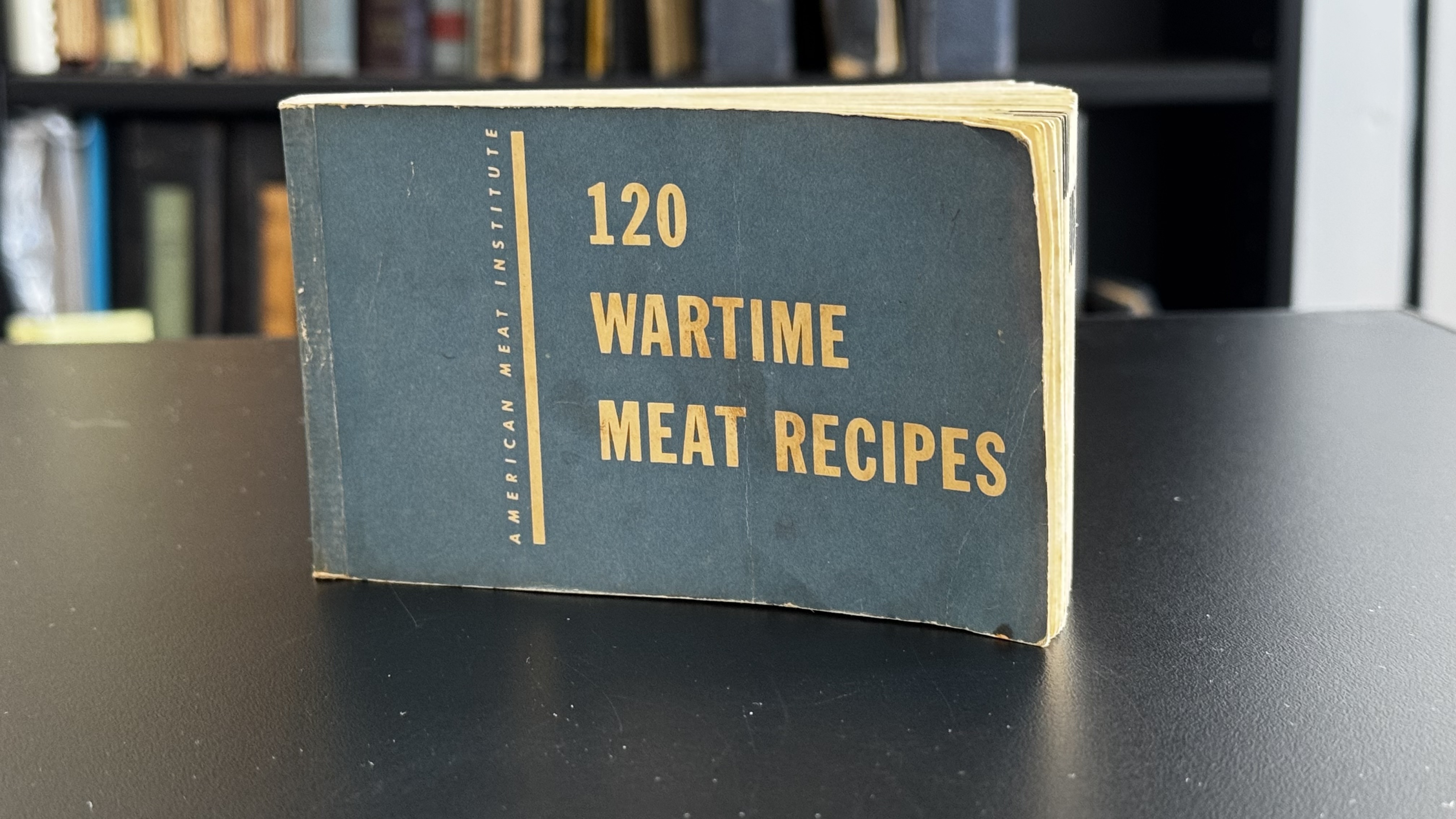
The War's Impact on the Food Supply
The recipes highlight a time during World War II when many staple foods became scarce, as they were used to feed troops, and rationing was a requirement. 120 Wartime Meat Recipies encourages families to use a variety of cuts (page 4), including organ meat like the heart, kidney, tongue, or sweetbreads (the thymus and pancreas glands).
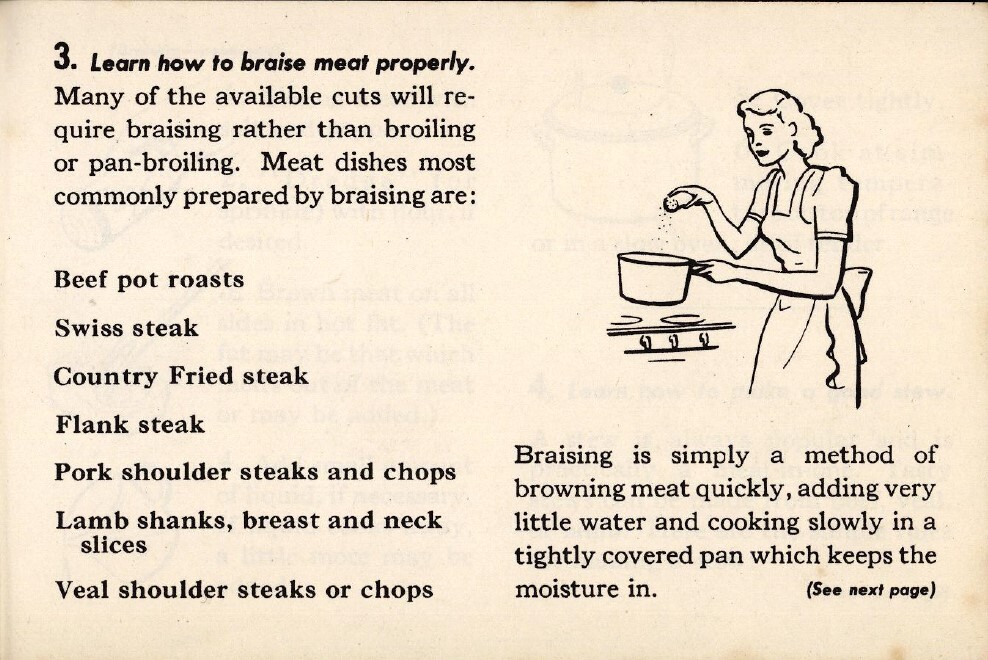
It also promotes cooking techniques (page 5) that reduce waste and emphasizes slower cooking methods, like braising. Braising, which involves long, slow cooking in liquids at a lower temperature, tenderizes cuts that can be tough if cooked quickly by grilling or broiling.
It also promotes cooking techniques (page 5) that reduce waste and emphasizes slower cooking methods, like braising. Braising, which involves long, slow cooking in liquids at a lower temperature, tenderizes cuts that can be tough if cooked quickly by grilling or broiling.
I am lucky enough to have eaten some of the more unusual cuts in this book (so you don’t have to!) and want to highlight one cut that has all but disappeared from most tables.
The beef and pork brain.
Brains were a Midwest working-class food that rose in popularity in the late 19th century. 120 Wartime Meat Recipes includes several brain recipes using both beef and pig brains (page 32).
Warbirds and Brains
Growing up, we would visit family in Evansville, Indiana. My great-grandmother had two foods she would regularly make for me and my siblings: home-baked cinnamon rolls and the fried brain sandwich. The cinnamon rolls were always welcome, but we kids stopped eating the brains when we realized the pale, fried patty was truly a brain.

Evansville was, of course, home to one of Republic Aviation’s factories during WWII. The factory where AirCorps Aviation's P-47D Thunderbolt project “Bonnie” originally rolled off the line. Bonnie is the only flying Republic-built Razorback P-47D in the world. It makes you wonder how many fried brain sandwiches helped power the workers who built planes like Bonnie at the factory.
Evansville is one of the few places where you can still find the fried brain (pork) sandwich on the menu at restaurants. It has become a regional delicacy. My dad, who grew up in Evansville, makes sure to let me know he enjoyed a brain sandwich when he goes back for the city’s century old annual Fall Festival.
Evansville is one of the few places where you can still find the fried brain (pork) sandwich on the menu at restaurants. It has become a regional delicacy. My dad, who grew up in Evansville, makes sure to let me know he enjoyed a brain sandwich when he goes back for the city’s century old annual Fall Festival.
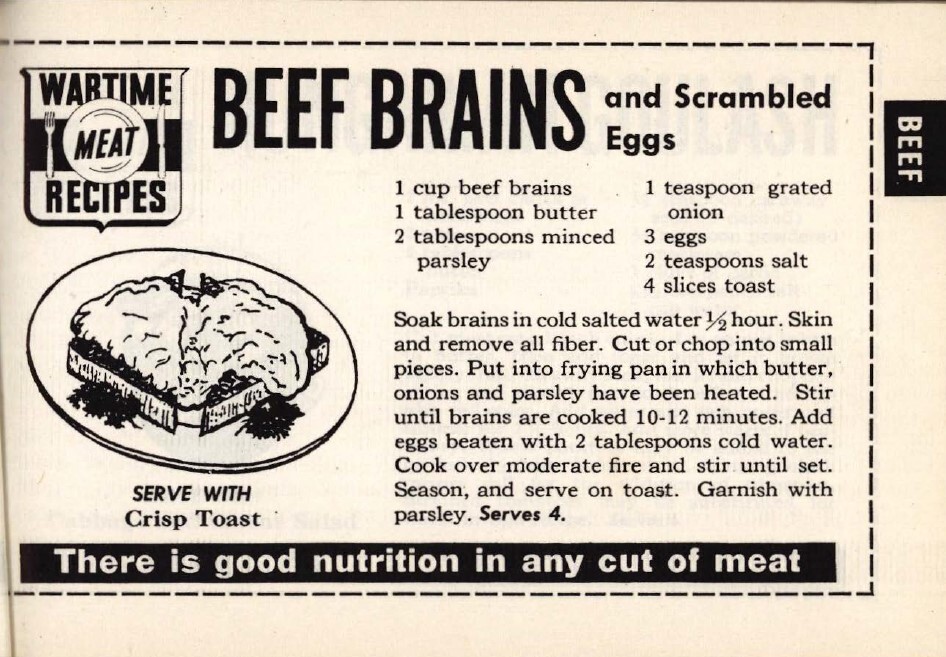 While 120 Wartime Meat Recipies doesn’t include a fried brain sandwich, it does include a brains and eggs recipe (page 42), another working-class combination immortalized on the menu of the historic Oxford Saloon in downtown Missoula, Montana. The miners and loggers who frequented "the Ox", as it is known locally, in the late 1800's could ask for a “He Needs ‘Em” and be served up a hot plate of brains and eggs.
While brains may be the most unusual cut of meat in 120 Wartime Meat Recipes, many of the other cuts you may be unfamiliar with can still be found on menus. Beef tongue (page 34), or lengua, is popular in street tacos, and the sweetbreads (page 43) we mentioned earlier have seen a resurgence in the past 20 years in gourmet cuisine. Both of these ingredients benefit from the low-and-slow cooking methods, highlighted in the book.
What About the Recipes!?!
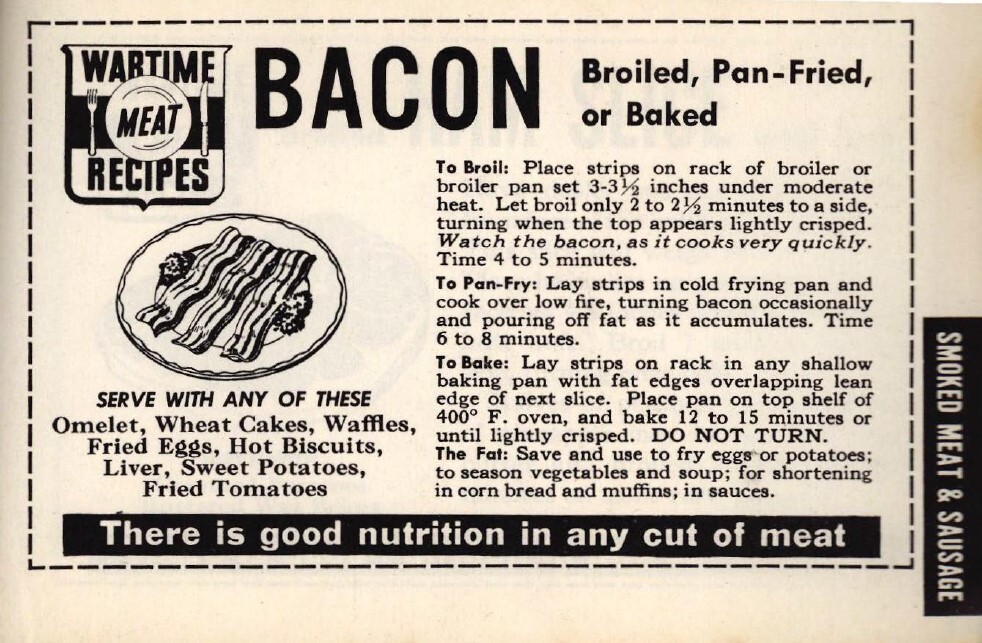
Outside of the unusual cuts of meats, the recipes are mixed bag that can feel pretty dated, but do include some classic combinations. In all my years I don't think I would have ever considered braising pork chops in evaporated milk (page 15). However, lamb and mint jelly (page 84) has been a standard on many restaurant Easter buffets for decades. If you are looking for one recipe to try that is sure to be a hit at your family's next function I would suggest this gem that can be found on page 126.
Special thanks to AirCorps employee Aaron Prince for sharing this booklet with us.
At AirCorps Library we love food almost as much as we love warbirds and are always excited to learn how these two topics intersect. If you are interested in more check our blog post on what a Mustang component has in common with a muffin pan.
At AirCorps Library we love food almost as much as we love warbirds and are always excited to learn how these two topics intersect. If you are interested in more check our blog post on what a Mustang component has in common with a muffin pan.